Structure
TraceBoardStructure and trace engineering work: requirements, tasks, bugs, tests, links, risks, hazards and baselines.
REQ-042
linked to implementation work
linked to implementation work
TraceBoard Suite
Connect requirements, work, verification and evidence in one connected engineering system.
The engineering model stays deterministic and inspectable. AI can assist with importing, analysis, querying, generation and narratives; your team reviews what becomes committed engineering data.
Built with the rigor regulated engineering requires. Designed without the bureaucracy it doesn't.
The engineering model
01 — The foundation
Requirements, risks, tasks, tests and evidence remain connected. Instead of scattering engineering relationships across separate tools and documents, TraceBoard Suite keeps the links available as the work changes.
The model represents recorded engineering items and explicit relationships. Deterministic calculations can show what those relationships contain; they cannot infer a relationship that was never entered.
02 — Engineering chain
The chain is a model of connected engineering relationships, not a mandatory workflow. Use the entities that make sense for your project.
Recorded relationships can feed documentation, standards-aware evidence and review preparation where required.
03 — Fit the process to the work
Use the structure you need. No unnecessary process overhead. TraceBoard Suite supports regulated and safety-critical engineering without requiring every team to adopt a regulated workflow.
For SaaS products, embedded software, industrial software, AI-enabled products and teams outgrowing spreadsheets.
For medical software, automotive, defence and industrial or safety-critical engineering where additional rigor matters.
Start simple. Add hazards, risks, baselines, tests and evidence as your needs grow. These capabilities are available to everyone; they are not hidden behind a special compliance mode.
04 — The suite
TraceBoard, TraceDocs and TraceTest are specialized services with shared project and item references, operating around the same recorded engineering data.
Structure
TraceBoardStructure and trace engineering work: requirements, tasks, bugs, tests, links, risks, hazards and baselines.
Document
TraceDocsCreate controlled documentation from engineering data and selected baselines, with links back to items.
Verify
TraceTestExecute test runs, record results and evidence, and report coverage connected to engineering items.
05 — Optional AI capability
AI can operate against configured engineering context rather than inventing its own source of truth. Deterministic relationships remain inspectable, and human review remains authoritative.
06 — Real product evidence
These are real product views from the repository. The shared REQ-042 example makes the intended relationship explicit: one recorded engineering model, different specialized views.
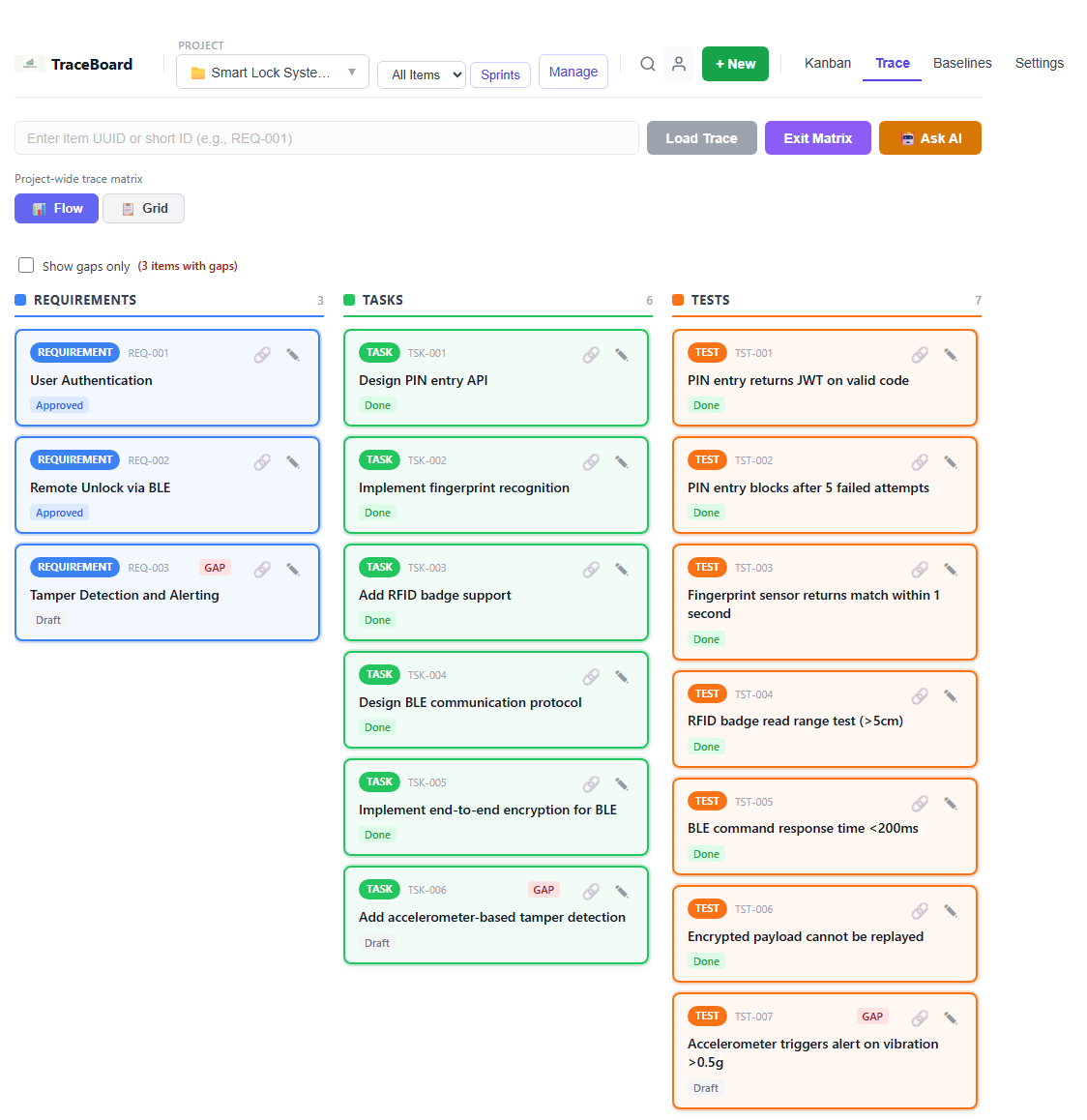
TraceBoard connects a requirement to engineering work.
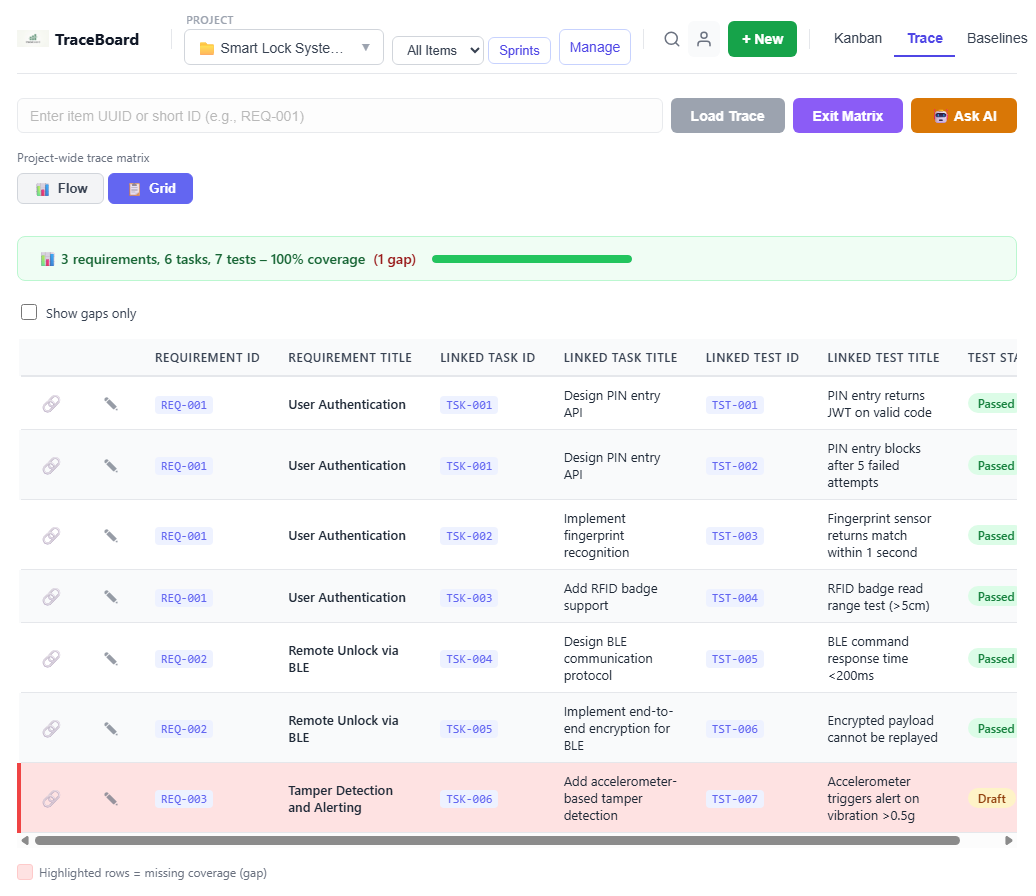
See engineering entities and their links together.
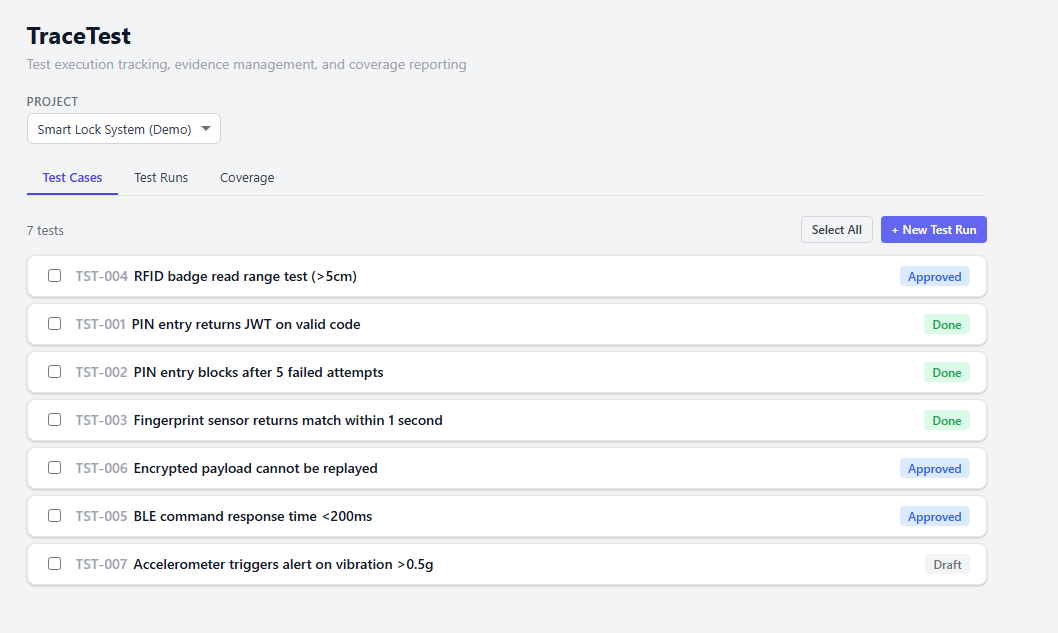
TraceTest records execution and coverage against the same requirement.
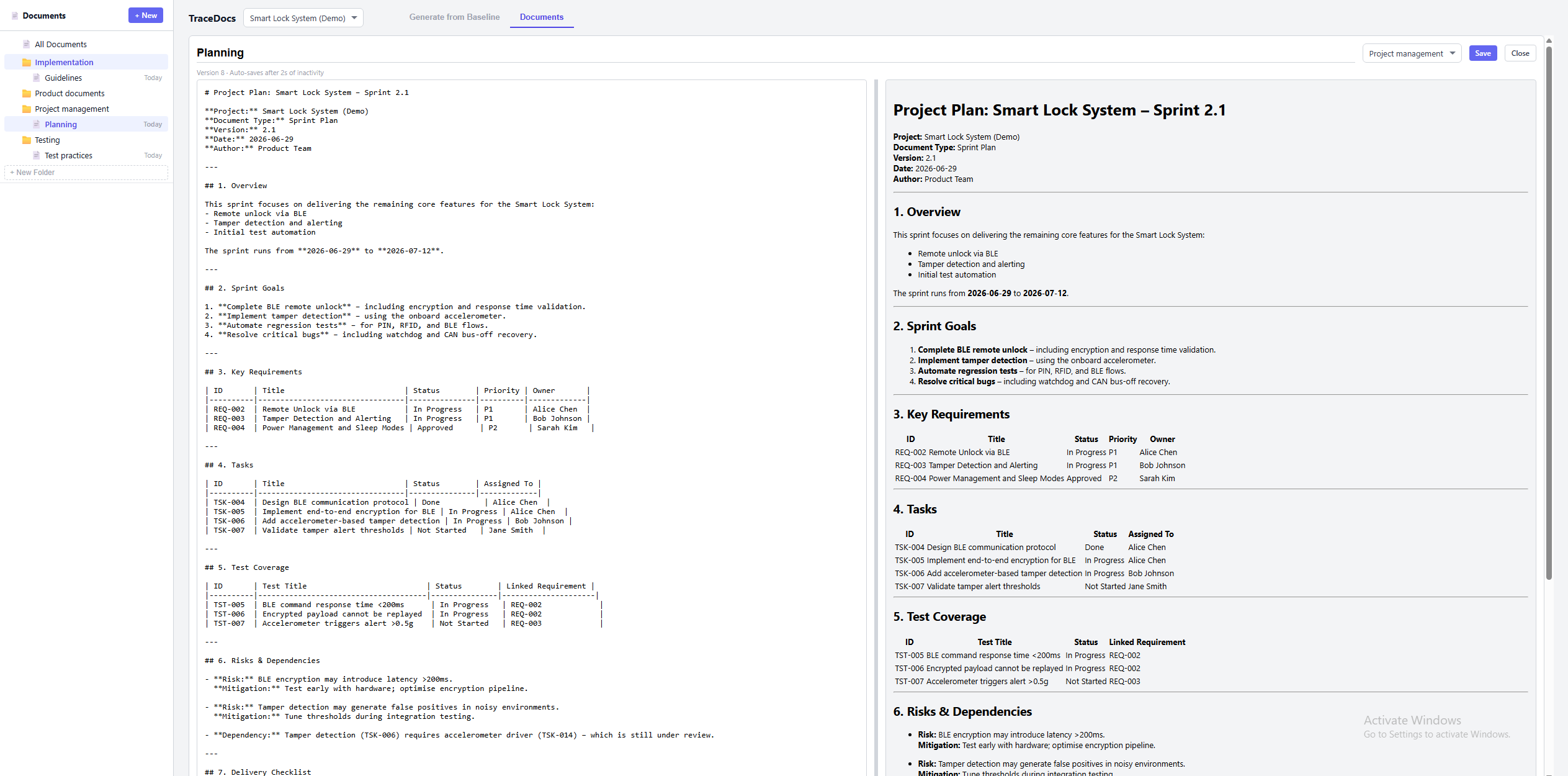
TraceDocs turns controlled engineering data into documents.
07 — Engineering State
Engineering State is a deterministic, on-demand aggregate across compliance assessment, traceability, verification, risk, consistency, change impact and baseline readiness. It is calculated from recorded engineering facts and defined thresholds—not an AI opinion, certification score or release approval.
Baselines capture a point in the engineering model for comparison, traceability and documentation. They help answer what changed without implying that the snapshot itself proves correctness.
Recorded results, assessments, relationships and documents remain connected so teams can review the evidence behind a project state.
07 — Why existing tools struggle
Excel, Jira and Confluence can each be useful. The difference is the underlying engineering model, not a claim that one general-purpose tool is simply “better.”
Flexible, but controlled engineering traceability and relationships are difficult to maintain manually.
Excellent for task and project management, but not designed as the engineering system of record.
Excellent documentation platform, but engineering verification and relationships are not its core model.
08 — Pricing
Self-hosted tiers let you choose the suite scope that fits your team. Detailed feature coverage remains available below.
€0
30 days · up to 5 users · full current feature set.
Download trial kit€999 / year
Up to 5 users · TraceBoard.
Request activation€2,490 / year
Up to 15 users · TraceBoard + TraceDocs.
Request activation€5,990 / year
Up to 40 users · full suite, TraceTest and SSO (OIDC).
Request activationBusiness (€11,990 / year, up to 100 users) and Enterprise custom tiers are also available. Contact sales.
| Capability | Starter | Professional | Team | Business |
|---|---|---|---|---|
| Requirements, tasks, bugs, tests | ✓ | ✓ | ✓ | ✓ |
| Baselines and traceability | ✓ | ✓ | ✓ | ✓ |
| TraceDocs | — | ✓ | ✓ | ✓ |
| TraceTest execution and coverage | — | — | ✓ | ✓ |
| SSO (OIDC) | — | — | ✓ | ✓ |
09 — Deployment and control
Self-host the core suite on customer infrastructure. Local AI can keep model requests inside your network when configured that way; OIDC, remote Git and cloud LLMs require their external services.
TraceBoard Suite runs as a Docker Compose stack with its own databases on your server or infrastructure. The 30-day trial downloads as a single zip: unzip it, run ./start.sh (Linux/macOS) or .\start.ps1 (Windows), and the suite is available at http://localhost. Docker Desktop or Docker Engine with Compose v2 is required.
A local Ollama or OpenAI-compatible endpoint can support local AI operation. Air-gapped use depends on the configuration and integrations you select.
Use supported JSON, CSV, XLSX, PDF and DOCX operations rather than assuming arbitrary full-fidelity interchange.
10 — FAQ
No. TraceBoard Suite works for any engineering team. Standards-aware capabilities are available when needed, but teams are not forced into a regulated workflow.
There is no unnecessary process overhead. Teams can start with requirements and tasks and add risks, hazards, tests, baselines and evidence as their engineering needs grow.
No. Capabilities such as baselines, traceability and evidence-linked verification are available to all users. They are not hidden behind a special compliance mode.
TraceBoard structures engineering work, TraceDocs creates controlled documentation from engineering data and selected baselines, and TraceTest verifies through runs, results, evidence and coverage connected to engineering items.
Engineering State is a deterministic aggregate of the project's recorded engineering model across compliance assessment, traceability, verification, risk, consistency, change impact and baseline readiness. It identifies where the recorded model needs attention; it is not certification or release approval.
The core suite can be self-hosted and local AI can run through a configured local endpoint. OIDC, remote Git integrations and cloud LLMs require connectivity to those external services.
AI is optional. It can propose, analyze, generate, query, import or narrate within configured context; deterministic relationships remain inspectable, and a human decides what becomes committed engineering data.
11 — Get started
Start with the structure your team needs today. Add rigor as the work demands it.
The trial download is an evaluation build. For questions about information submitted through this website, trials, or support, contact [email protected]. Formal website privacy information and terms of service are not currently published.